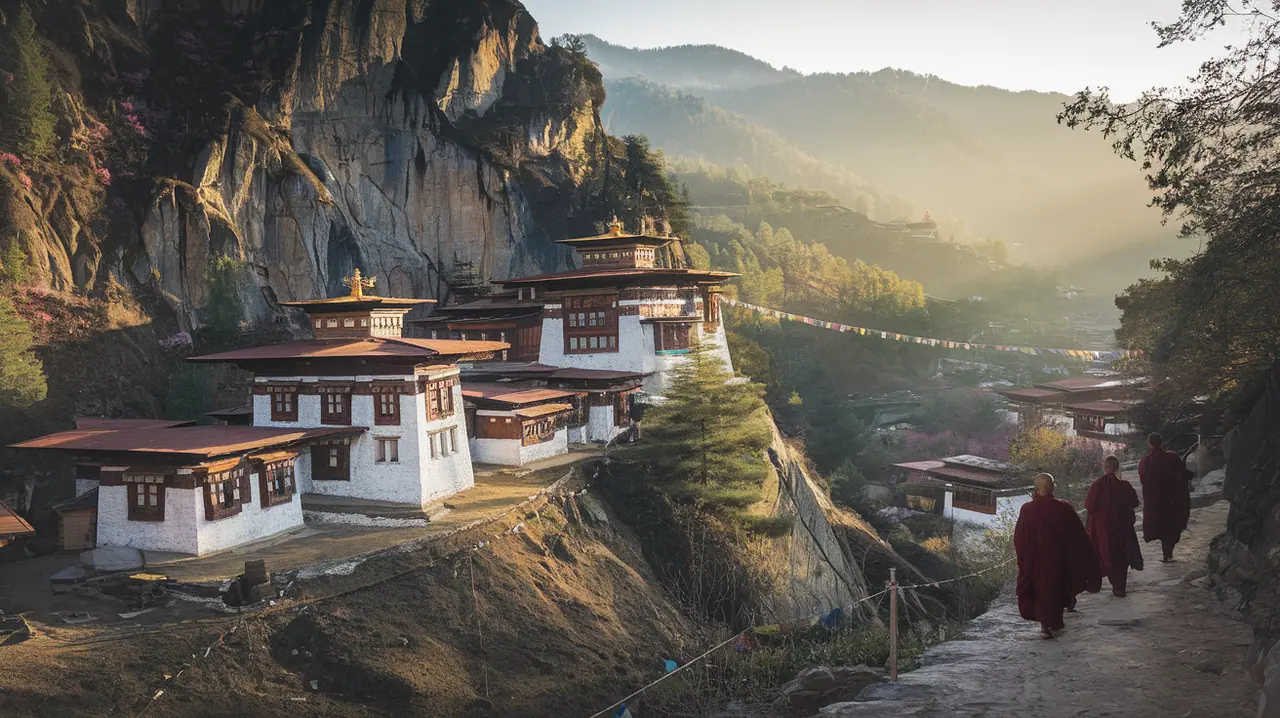
Bhutan — The Royal High Climes
Bhutan produces small quantities of cliff honey from the same rhododendron belts as Nepal, but under much stricter state-level environmental controls.
Anecdotally high; different active plant compound isoform ratios than Nepalese due to species differences.
Very dark amber, cleaner and less bitter than some Nepalese batches.
Spring (April-May) and limited autumn harvest
Why Bhutan is the rarest origin
Bhutan produces mad honey — it has the same geography, the same bee species, and many of the same Rhododendron species as Nepal — but you almost never see it on international markets. Understanding why requires understanding Bhutan's distinctive approach to commerce, environment, and traditional harvesting rights.
Geography and botany
Bhutan's honey-producing terrain lies in the western and central valleys — Haa, Paro, Thimphu, and Punakha — at altitudes of 2,500 to 4,200 meters. These valleys sit on the same Himalayan arc as Nepal's honey-producing districts but with distinctive local flora. The dominant Rhododendron species include R. grande, R. falconeri, and — at the highest elevations — R. campanulatum.
Bhutan's protected Rhododendron sanctuaries host over 40 native species of the genus, including several found nowhere else. The national focus on Rhododendron conservation (Rhododendron is featured in the national Gross National Happiness index indicators) limits industrial-scale honey harvesting in ways that don't exist in Nepal.
Regulatory environment
Bhutan Agriculture and Food Regulatory Authority (BAFRA) regulates domestic food production and export tightly. Mad honey is legal for domestic sale and consumption — there's a modest but consistent internal market, primarily for traditional medicinal use — but export is restricted by a combination of factors:
- Environmental protection priorities. Bhutan has voluntary constraints on any commercial activity that could pressure Rhododendron habitat.
- Traditional harvesting rights. Local communities maintain customary access rights that are respected in ways that commercial-scale operations would disrupt.
- Commercial scale limits. Bhutan's overall agricultural export focus is narrower than Nepal's; honey is not a priority export category.
Traditional harvesting
Bhutanese honey harvesting traditions share features with Nepalese ones — cliff harvesting of Apis laboriosa hives, bamboo ladders, seasonal timing — but are conducted at smaller scale and with tighter community control. Individual cliffs are traditionally clan-held, and outside commercial buyers must negotiate through local cooperative structures.
The Drukpa ethnic groups of western Bhutan have a honey-harvesting tradition that parallels the Gurung tradition of central Nepal but without the commercial export scaling that has occurred on the Nepalese side since the 2010s.
What Bhutanese product is like
When you do encounter authentic Bhutanese mad honey, it is typically:
- Very dark amber, sometimes verging on deep brown with reddish undertones.
- Higher in R. grande and R. falconeri nectar than Nepalese product, giving it a slightly different active plant compound isoform distribution.
- Cleaner in pollen analysis (fewer co-bloom species) because the harvest is lower-yield and harvesters can select the best combs.
- Significantly more expensive per gram — typical $120–$250 per 100g when available.
Anecdotally, Bhutanese product is described as having a "cleaner" effect profile — less of the bitter aftertaste associated with some Nepalese batches and a more gradual onset. This is unverified; published clinical comparison doesn't exist.
Brands that source partially from Bhutan
The only brand we index that claims Bhutanese sourcing is Stoned Mad Honey, which blends Nepal and Bhutan sourcing. No brand exclusively sources from Bhutan on the US or EU market as of April 2026. Occasional small-batch Bhutanese product appears through boutique Asian wellness channels.
How to identify Bhutanese-origin product
Three verification angles:
- BAFRA export certification. Legitimate Bhutanese export should carry BAFRA paperwork.
- Pollen analysis. Dominant R. grande or R. falconeri pollen (distinguishable under microscopy from R. arboreum) indicates Bhutanese origin.
- Price. If it's cheaper than $100 per 100g, it is unlikely to be genuine Bhutanese.
The future of Bhutanese mad honey
Bhutan has begun a cautious expansion of commercial Rhododendron-based products (teas, extracts, small-scale honey) in the 2020s. Whether mad honey will scale into an exportable category depends on how the Bhutanese government balances commercial opportunity against environmental and cultural preservation priorities. Current signals suggest measured expansion rather than a surge.
For buyers, that means Bhutanese product will likely remain rare and premium. If you encounter it with proper documentation, it's a distinctive experience worth having.