What "Himalayan mad honey" actually means
"Himalayan" is the most-used and least-precise term in the category. Technically, any mad honey from the greater Himalayan arc is "Himalayan mad honey." In practice it is a marketing umbrella covering product from Nepal, the northern Indian states of Uttarakhand, Sikkim, Arunachal Pradesh, and parts of West Bengal (the Darjeeling belt), and western Bhutan. The botany is broadly similar across this arc — cliff-nesting Apis laboriosa foraging on high-altitude Rhododendron species — but the harvesting traditions, regulatory status, and commercial access vary sharply by jurisdiction.
When you see a product labeled simply "Himalayan mad honey," ask the seller to specify the country of origin. Nepal is the most common default; Indian Himalayan product is rarer on export markets; Bhutanese product is essentially unavailable commercially.
The Himalayan Rhododendron arc
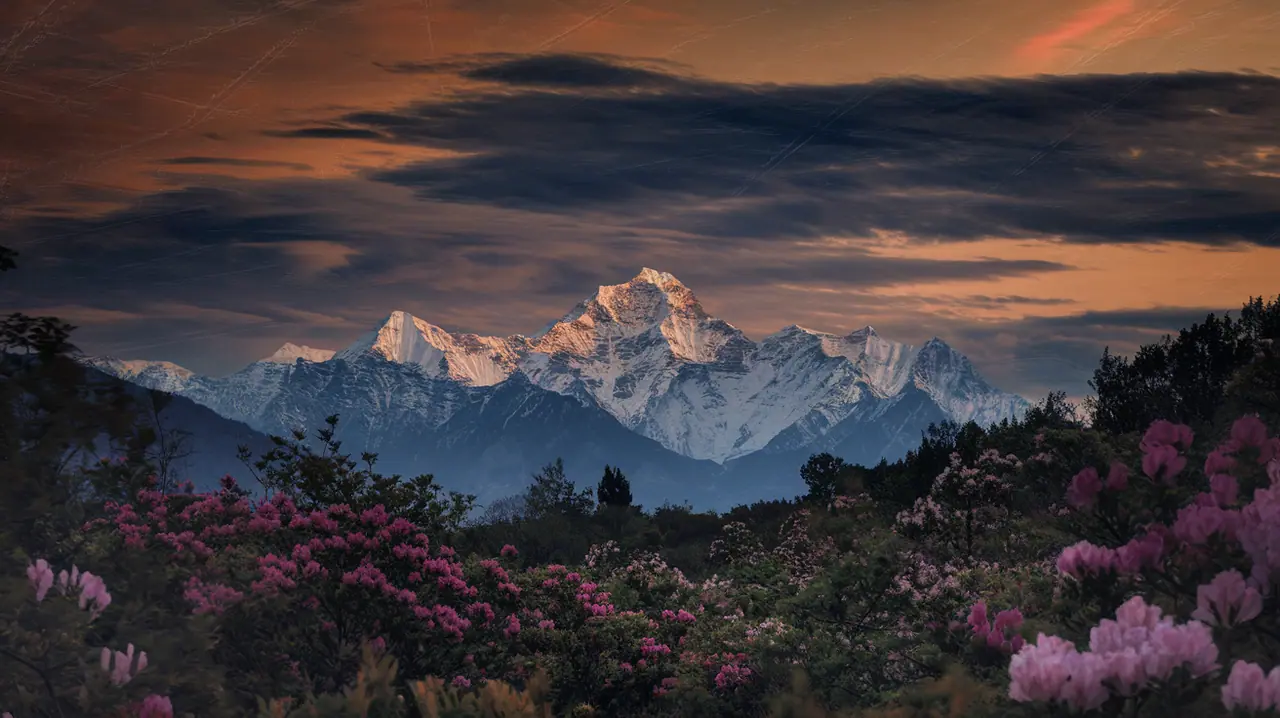
The Himalaya hosts more Rhododendron species than any other region on earth — more than 80 native species distributed across altitudinal belts from 1,500 to 4,500 meters. The species most relevant to mad honey production are R. arboreum (dominant at 2,000–3,500 m), R. campanulatum (3,500–4,200 m), and in Sikkim and Bhutan, R. grande and R. falconeri. Each species produces nectar with slightly different active plant compound isoform ratios.
The bloom sequence runs from late March at lower elevations through late May at upper elevations, creating a "bloom wave" that bees track upward as the season progresses. Harvesters time their work to the wave.
Nepal vs. India vs. Bhutan
Nepal
Nepal dominates the commercial Himalayan market. We cover Nepal in depth on our dedicated Nepal origin page. The combination of Gurung/Kulung harvesting traditions, mature export infrastructure, and concentrated production in the Kaski/Lamjung/Gorkha districts makes Nepal the default for most "Himalayan" product.
India — Uttarakhand, Sikkim, Darjeeling
Indian Himalayan mad honey production is smaller-scale and more dispersed. Uttarakhand (particularly the Kumaon region) has a tradition of rock-face honey harvesting similar to Gurung practice, though without the same degree of ritual codification. Sikkim's honey-harvesting communities overlap with Bhutanese and Tibetan cultural zones and work in harder-to-access terrain. The Darjeeling belt produces honey primarily on the Indian side of the border with eastern Nepal — often sold simply as "Darjeeling honey" without explicit mad-honey framing.
Indian production has been held back commercially by Food Safety and Standards Authority of India (FSSAI) regulation of the novel-food category. Brands selling Indian Himalayan mad honey internationally are rare; a growing domestic market serves Indian and South Asian consumers within India.
Bhutan
Bhutanese mad honey is produced in small quantities from the same Rhododendron belts as Nepal but under much stricter state-level environmental control. See our Bhutan origin page. The short version: almost none of it leaves the country.
Why the cross-border framing matters
Three reasons to understand the cross-border distinction:
- Regulatory implications. A seller labeling product "Himalayan" without specifying country avoids committing to any particular national food-safety regime. For buyers in regulated markets (EU, UK, Canada), this ambiguity matters — country-of-origin affects customs processing.
- Fair-trade implications. A "Himalayan" label can mask the fact that the product is Nepal-sourced but imported into India or China for relabeling, cutting Nepalese honey hunters out of premium pricing. Ethical buyers should prefer sellers who specify the cooperative they source from.
- Potency implications. Different Rhododendron species produce different active plant compound profiles. "Himalayan" per se does not predict potency; country and species do.
Himalayan honey-hunter cultures
Beyond the Gurung and Kulung of central Nepal, the Himalayan arc hosts several other honey-hunting traditions:
- Rai and Limbu (eastern Nepal / Indian Darjeeling border) — rock-face honey harvesting with bamboo ladders, similar technique to Gurung but culturally distinct.
- Lepcha (Sikkim) — traditional rope-and-basket harvesting in high-elevation Rhododendron forests.
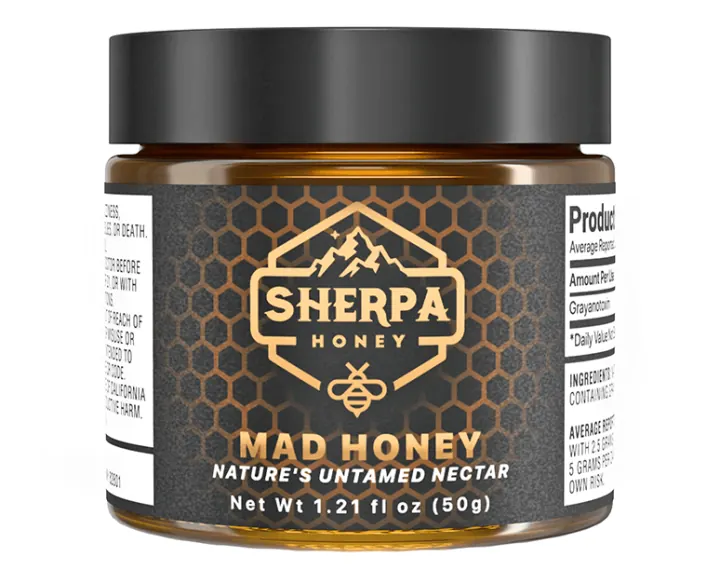
- Sherpa (Solukhumbu, eastern Nepal) — predominantly high-altitude pastoralists with some honey-harvesting tradition; associated with the Sherpa Honey brand via Annapurna district partnerships.
These traditions share a risk-acceptance profile: harvesters descend sheer cliffs with minimal safety equipment because the economic reward — and increasingly the cultural identity tied to the work — justifies it. Ethical brands treat this risk profile as a sourcing input that should command premium pricing.
Bloom-wave timing across the arc
The Himalayan Rhododendron bloom wave is one of the continent's great botanical phenomena. The wave begins in late March at 1,500 meters in eastern Nepal and northern India, moves west and up through April, reaches peak coverage across Nepal in early May, and finishes at 4,000+ meters in mid-to-late May. Autumn brings a secondary, smaller bloom triggered by rainfall patterns.
For buyers tracking harvest timing, this matters: the April-May spring harvest produces peak-potency honey; autumn (September-October) produces milder honey with a broader nectar mix.
Counterfeiting across the region
Cross-border trade creates counterfeiting opportunities. Common patterns:
- Nepalese product relabeled as "Indian Himalayan" to access Indian wholesale channels.
- Indian or Chinese commercial honey blended with small quantities of genuine mad honey and sold as "Himalayan mad honey."
- Early-season or off-peak batches from any Himalayan country sold at full-potency prices.
The best defense is buying from brands that publish origin documentation — country, cooperative, harvest date, pollen analysis. Generic "Himalayan" without these specifics is a red flag.
For buyers: how to read a "Himalayan" label
Ask three questions:
- What country is this from?
- What Rhododendron species dominate the harvest?
- Can I see a pollen analysis or batch report?
A seller who can't answer all three is not one we recommend buying from. The brands indexed on Mad Honey Finder are selected in part because they can answer these questions consistently.